HUG Your Baby Website
PO Box 3102 Durham, NC USA
Showing posts with label Japan. Show all posts

Japanese Nurse Incorporates HUG into her PhD Research

Development of a Web-Based Comprehensive Educational Programme for Nurses to Facilitate Mother-Infant Bonding
Yasue Otal,  Mari Takahashi 
 Juntendo University graduate school of health care and nursing Doctoral course 
 Juntendo University Faculty of health care and nursing
Juntendo University graduate school of health care and nursing

Background: 
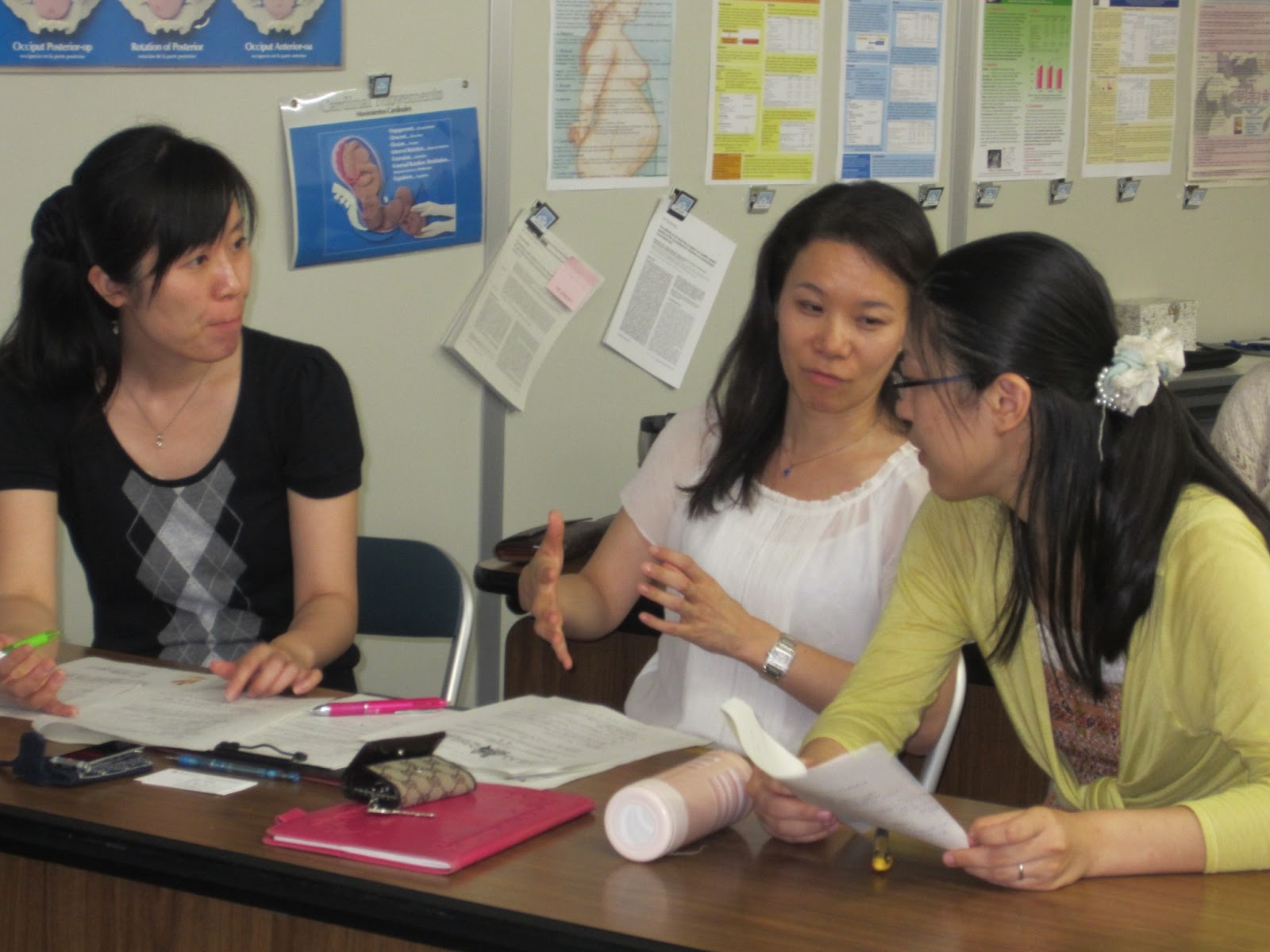
Yasue Ota on right
The acknowledgement of the importance of the role nurses can play in facilitating mother-infant bonding during the very early postnatal period has created many interventions. But most of them don’t seem to function as well as expected due to low availability, and requirement of rigorous training and certification. This motivated us to develop a user-friendly, easy-to-access, web-based comprehensive training programme for nurses to effectively enhance their responsiveness to postnatal mother-infant bonding.

Methods: 
First, observations of nurses and mother-baby dyads were conducted. Then, semi-structured interviews with those nurses were implemented to generate a structural nursing care model for facilitating mother-infant bonding during the early postpartum period. Finally, this model and a literature review were synthesized. And then the theory of the ICE model (F. Young) and the Reflective approach model (G. Gibbs) were applied to design our educational programme. It was pilot-tested with ten midwives at a birth centre.
Results: Our educational programme comprises a web-based programme and a case study through reflection on clinical practice. The web-based programme has three following steps: Step 1, application of HUG Your Baby programme (J. Tedder) to enhance knowledge and skills about infants’ behaviours; Step2, construction of effective communication skills and sustainable childrearing support to engage as an “Attacher”, who helps enhance mother-infant bonding and; Step 3, case studies for incorporation of acquired knowledge and skills into clinical practice. The process evaluation generated positive feedback regarding its course length, interestingness and levels of difficulty.

Conclusion: 
This comprehensive educational programme for nurses has the potential to contribute to facilitating nurses’ responsiveness to infants and mother-infant bonding in the early postnatal period.
Keywords: early postnatal nursing care, mother-infant bonding, educational programme


References: 
Yasue Ota, Mari Takahashi (2016). Nurses’ support to facilitate mother-infant attachment during the early postpartum period. Japanese Journal of Maternal Health, 56(4), 618-625.

Japanese Certified HUG Teacher Helps a Mother Avoid Giving Formula

Yasue Ota has been a registered midwife in Japan for about 10 years and is now teaching maternity nursing and midwifery at Juntendo University in Chiba. Yasue discovered The HUG website and was attracted to the words, ‘Baby Zones and SOSs’. Yasue thinks that “HUG Your Baby Zones and SOSs” are such a wonderful and easy tool to help new parents understand their baby.

Read the exciting account, below, of how using The HUG kept one Japanese mother from giving formula!

I visited Maya when she was 2 weeks old. That was just 1 week after leaving the hospital. Her mother, Tomoko, told me that Maya cries all the time. Tomoko felt that perhaps her breast milk is not enough for her baby. So Tomoko was wondering if her baby might need a little formula. I shared with Tomoko the following ideas about a baby’s crying:

Most normal, healthy babies begin to cry more around forty-two weeks gestation, or two weeks after birth (if the baby was born full-term). Babies typically move from crying two hours a day to crying three hours a day by six weeks of age. Then their crying tapers to about one hour a day by twelve weeks of age.

I explained some easy-to-remember tips to Tomoko, who says what all new parents holding a crying baby say: “Just tell me what TO DO!” Sharing HUG Your Baby concepts, I told Maria:

T – Talk to your baby. Lean over and use a persistent, sing-songy voice close to her ear. Give your baby a few seconds to notice and respond to your voice.

O – Observe your baby's efforts to contribute to his own calming.

Maya was crying loudly while I talked to Tomoko. We paused to observe Maya’s efforts to calm herself. We were delighted to see Maya bringing her hand to her mouth, sucking her finger, and starting to quiet. Tomoko was surprised to learn that babies have instinctive behaviors that help them calm down.

I added another tip to DO (to calm the baby): If the baby is still crying, hold her arms against her chest and continue that quiet, persistent talking—and encourage the baby to suck your finger or the breast, or swaddle her safely.

Maya started to cry again and Tomoko leaned over the baby and spoke quietly into her ear. When Maya continued to cry Tomoko waited a moment and then noticed that the baby smacked her lips. The baby then quiets right down when Tomoko holds her tiny but strong arms securely against her chest. With a smile on her face, the mother then brought the baby to the breast for a good feed. “Now I see how I can work it all out without any formula!” Tomoko tells me.


I really feel pleasure in seeing the "ah ha" moments parents have when I use The HUG ideas and teaching strategies as they relate to their individual baby. I think HUG Your Baby is such a useful tool for facilitating breastfeeding, fostering mother-baby bonding, and enhancing parent confidence.

Japan: Country Representative

Japan's Director of HUG Education and Research: 
Yoko Shimpuku, RN, CNM, PHN, PhD, CHT, has worked clinically as a nurse midwife in both hospitals and birth centers in Japan. She earned her PhD from the University of Illinois at Chicago. Yoko's work has been published in peer-reviewed journals and presented at international conferences. She conducts research in Tanzania for the education of pregnant women, adolescent girls, and local midwives. A former intern with the WHO, Yoko's international efforts have been recognized with multiple research grants and awards. She is an Assistant Professor at St. Luke’s College of Nursing, Tokyo, and created the Japanese HUG website andFacebook page. Contact Yoko at yokokitty@gmail.com  Read about The HUG in Japan.

Japan: Article Gives Feedback about The HUG

A Japanese colleague, Yoko Shimpuku, PhD, CNM, RN, and I wrote a recently published article that describes the impact of bringing HUG Your Baby to Japan.

(2013).  HUG Your Baby: Evidence-based support tool for early child rearing.  Japanese Journal of Nursing Education 54(12): 1114-1118.

Since some of you may need to brush up on your Japanese in order to read it, I want to share the content of this article in English! The article includes:
  • A summary of the challenges childbearing families in Japan face today: 
    • decreased fertility rates
    • increased average age of new mothers
    • isolation of young mothers due to decreased proximity of the nuclear family
    • long working hours of fathers
  • Academic background of HUG Your Baby: Based on the research and writings of leaders in the pediatric and child development world including: 
    • Dr. T. Berry Brazelton and his colleagues, Dr. Kevin Nugent and Dr. Edward Tronick
    • Drs. Stella Chess and Alexander Thomas
    • Dr. Mary Ainsworth
    • Drs. Marshal and Phyllis Klaus
  • Components of the HUG Your Baby Program: Innovative and family-friendly language helps parents 
    • observe three newborn "Zones," including the "Resting - sleeping Zones," the "Ready - 'I am ready to eat or play' - Zone," and the "Rebooting - fussing or crying Zone";
    • notice "Body SOSs" (changes in color, movement and breathing) and the "Behavioral SOSs" ("Spacing Out," "Switching Off," and "Shutting Down"), in order to
    • prevent and solve problems around a baby's eating, sleeping crying and parent-child interaction.
  • The feedback received from nurses who completed an evaluation of the HUG Your Baby workshop they attended in Japan.

"The HUG Your Baby workshop gave me useful 
skills and resources to teach and support new parents."


"The HUG Your Baby ideas and resources 
are appropriate for my culture."


Japan: Yoko Shimpuku, PhD, Shares The HUG in Japan!


Yoko Shimpuku, RN, CNM, PHN, PhD,  has worked clinically as a nurse midwife in both hospitals and birth centers in Japan. She also conducts research in Tanzania for the education of pregnant women, adolescent girls, and local midwives. Yoko is an Assistant Professor at St. Luke’s College of Nursing, Tokyo. Because Yoko believes that Japanese parents have much to learn from HUG Your Baby techniques and resources she has agreed to serve as HUG Your Baby's country representative for Japan. She has created "The HUG for Japan" website and Facebook Page and is translating many HUG materials into Japanese.  

My first encounter with Jan and HUG Your Baby was January 2013 when I was visiting my friend from graduate school at the University of North Carolina. In hindsight, it seemed like a miracle! If my friend didn’t get a job in North Carolina or if I didn’t get the funding to go abroad at that time, I would have never known about HUG Your Baby. After only a brief introduction to this program, I could imagine how mothers in Japan would benefit from the program. Jan and I connected well and  decided to develop HUG Your Baby resources for Japan.

In July 2014 Jan and her husband, Jim, came to St. Luke’s College of Nursing (now called St. Luke’s International University) where I am faculty. I asked several graduate students to bring their babies in order to demonstrate The HUG techniques. Jan immediately started observing the babies and pointing out what each baby could do. That day I witnessed first-hand HUG Your Baby's wonderful effects on Japanese mothers who were happy to learn about their babies and to be relieved of many worries.

During the next year, Jan requested that I serve as the Japanese representative of The HUG. We kicked off our Japanese outreach by collaborating on an article about HUG Your Baby which was published in The Japanese Jo. of Nursing Education [(2013)54(12): 1114-1118.]. A nursing professor who attended Jan's St. Luke's HUG presentation asked to make the Japanese HUG DVD available to public health nurses. This request motivated me to develop a Japanese website and later the HUG Your Baby Japan Facebook page. As word about HUG Your Baby started to get out, Japanese nurses, midwives, and OBs started asking, “What is this program about? How can I learn more?” I realized, even more that, The HUG is really needed in Japan!

Over these past few months I began making home visits on friends with young babies in order to complete my "parent visits" for the Certified HUG Teacher course. Since evaluating babies older than one month is not a usual part of my work,  I worried, “Could I explain these ideas well? What if I don't understand the baby’s behavior?” However, I soon realized that The HUG's online course had well prepared me for these visit. When I looked at a young baby I could now see and understand her SOSs, his increased crying, and her self-calming behavior. The mothers stated, “The HUG is really interesting! It works for my baby! Now my life is easier because I understand my baby and know how to comfort her.”


The voices of these mothers have encouraged me to bring more HUG Your Baby resources to Japan: an online course for professionals, “The Roadmap to Breastfeeding Success” handout and poster, and a handout to accompany the Japanese DVD. I am happy to have the opportunity to use The HUG to connect with Japanese mothers and to learn with them about what their babies are "saying." I hope that more and more mothers will come to know HUG Your Baby and gain new information and resources to care for and enjoy their lovely babies!

Japan: Tokyo University Gets The HUG!

Yesterday I began my final day of sharing HUG Your Baby with Japanese professionals. Though a shorter visit than I had at Kagawa University or St. Luke's International University, the time I spent at Tokyo University (with faculty and graduate students in Midwifery and Women's Health) was equally enjoyable and stimulating.

Tokyo University, referred to by some as the "Harvard of Japan," has been well known as a center of teaching and research since its inception in 1877. Our time here begins as midwives and Ph.D. graduate students, Sayaka Ashida and Kaori Yonezawa, give us a tour of their beloved campus.

We speak with them about their work as midwives, their passion for researching the medical care provided to mothers and their babies, and their hopes to eventually enter the world of academics as researchers and professors. They appreciate the HUG t-shirts (with Japanese sub-titles) that I brought from home for all organizers of HUG trainings.


As I walk around Tokyo University I continue to wonder about the importance of the little things I notice here. Today I am struck once again by the simple fact that mothers in Japan "wear their babies." Though my experience is clearly limited, I see baby slings of various styles, shapes and colors everywhere. On Sunday afternoon, when fathers are out for a stroll with the family, a stroller is often present carrying a bag while either mother or father happily tote a baby or larger toddler around the city. Even when I visit a hospital, to which mothers drive to from a distance, I never once see a mom carry her infant in a car seat. I spoke with one faculty member about American mothers' persistent habit of carrying babies around in their car seats, as ergonomically inappropriate as this is. She is surprised, and appalled. "It is so much easier for the mother, and better for the baby, to be in a sling or in mother's arms!"

The other thing I notice and wonder about is bowing. I have grown to LOVE bowing when greeting another. It seems like such a kind and respectful way to connect without physical touch. (Unlike the sometimes vigorous handshake of ladies in America, a bow is often followed by a gentle, almost vanishing, handshake with the women I meet here.)  The woman and man who load our luggage into the shuttle bus bow low as the bus takes off. I observe an electrician speaking to a plumber at a construction site; both men bow, hard hat to hard hat. Nurses bow when we met, when I complete a presentation, and before they ask a follow-up question one-on-one. I like the feeling a bow communicates. It relaxes me and makes me feel accepted here.

Though Tokyo University, like the other two universities I visited in Japan, has sophisticated lecture hall audio-visual equipment, I experience the same lack of success when I try to get my Macintosh presentation to "talk to" to the PC systems used by Japanese academics. Undeterred, I turned to my 3 inch by 3 inch Brownstone projector and tiny speakers to make my presentation here as I have done in other locations.

Though wording on all my HUG PowerPoint slides is in Japanese, and I plan to show my translated HUG DVD, I am surprised to be asked to make my presentation at Tokyo University in English, without a translator. I immediately miss the pace I had grown accustomed to of making a statement in English and having 30 seconds to plan my next statement while the translation occurs! As an American with a deficit in learning foreign languages, I can only imagine the effort it must take to try to understand new concepts as one's brain is busy translating foreign words. So I make an effort to be precise and clear in my descriptions of The HUG, my story-telling, and my discussions about the potential for HUG Your Baby's use in Japan.

With a smaller group of participants at this gathering, I am easily drawn into the interactive mode of teaching--techniques, I am told later, that are not commonly used by teachers in Japan. At first I ask Jim to "volunteer" to demonstrate the three "Body SOSs--Signs of Over-Stimulation" (changes in movement, color or breathing) and the three "Behavioral SOSs" ("Spacing Out," "Switching Off," and "Shutting Down"). The group is then asked to identify the SOS that Jim (as "baby") portrays. Then Jim plays a nurse who is helping me (a mother) understand the difference between deep and light sleep. Participants write down their responses to this exercise.

Next, this group of professionals are asked to take turns being "the nurse," as they practice explaining an SOS to their colleague (in the role of "the mother"). There is only a moment of awkward hesitation before the room breaks into active role-playing and fun-filled efforts to accomplish the task at hand.

Questions following my presentation focus quickly around issues of research, as many nurses describe their work and how HUG Your Baby might be used and studied.


One nurse is researching interventions used in postpartum depression. Do I think The HUG might be useful here? ("Yes, I think so!"). Another faculty member is taken with the research that is underway with undergraduate nursing students at University of North Carolina. Do I think Japanese undergraduate students might benefit from HUG Your Baby training?  ("Please try, and let me know.")  A Community nurse and lecturer wonders about the possible use of the translated HUG DVD with a group of new mothers. ("Wouldn't it be fun to collect feedback from mothers watching The HUG DVD for the first time?") Another member of the midwifery faculty is interested in how The HUG was used in a NICU setting. ("I will put you in touch with the author of that research.") [CLICK HERE for a link to HUG Your Baby research both completed and underway.]


You've heard it said that something looks "too good to eat."  So I take a picture, and then eat, eat, eat it ALL at the remarkable restaurant where Tokyo University faculty and students have generously taken us to dinner. Conversations with Jim and me continue around various research projects and HUG concepts.

But, numerous other conversations among our Tokyo hosts are energetically underway on subjects Jim and I can only guess about as we try (and enjoy!) "brown sake" for the first time ever!